This is the second part of a long piece of writing about Esther Gayton, a young ballet dancer from the early years of the nineteenth century whose name has been preserved through the folk music and dance world.
This section concerns the tunes, social dance and stepdance routine known to us today, whilst Esther Gayton part 1: the Ballerina and the Baronet looks at her personal life and stage performances from 1803-1809. I really recommend that you read that first, as it will fill out some of the references to ballet and theatre in this article – as well as the link with the barrel organ that went to the Arctic – and help put the longevity of these tunes and dances into context.
Social dance
It was common practice in the early 1800s for social dances to be named after celebrities and stage characters, and some seemed to stem directly from stage productions. A dance was named after Esther from her appearance in Tekeli; or the Siege of Montgatz. The show premiered at Drury Lane on 24th November 1806, and in August 1807, J. Pearce of Soho, was advertising “a new sheet of dances, No.3, including the Miss Gayton dance in Tekeli …”.
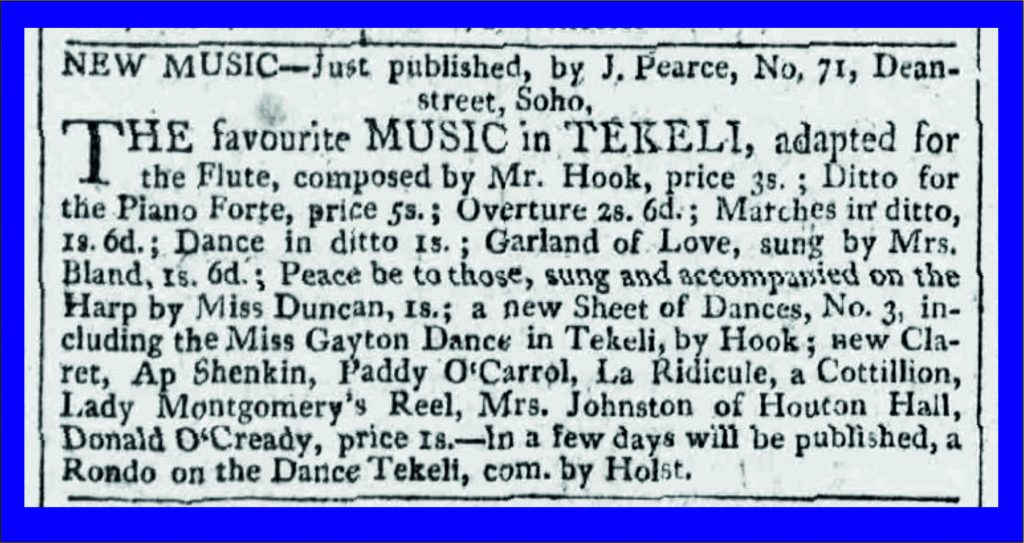
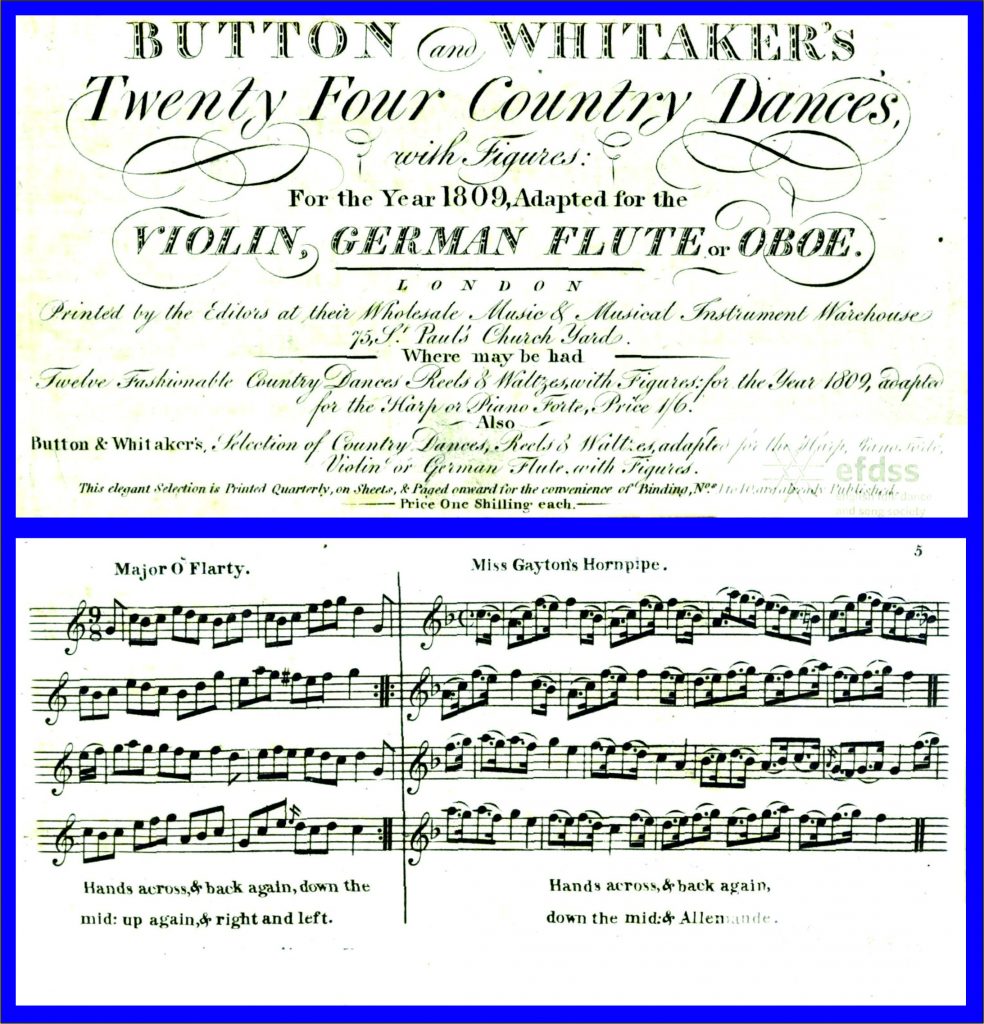
This would consist of the music and very brief dance instructions for a set of figures in the fashionable longways configuration of the time, and it seems very possible that it was published later in 1807 for the 1808 season in Vol.1 of Elegant and Fashionable Country Dances, Reels, Waltzes &c by Voight & Wheatstone (although the original booklet is not dated, expert opinion dates it to this season). We do however have all the details for a publication in late 1808, published by Button & Whitaker in their Twenty-Four Country Dances for the Year 1809 (as advertised in the Bury & Norwich Post on 24th November 1808). Whether the dance published by Pearce was the same or not, we won’t know unless a copy of that publication turns up sometime. Interestingly, the dance printed next to Miss Gayton’s Hornpipe in Button & Whitaker, Major O’Flarty, is not named after a real person, but a stage character (see Will the real Paddy O’Rafferty please stand up).
There was also another dance and tune called Miss Gayton’s Fancy published around the same time in another of Button & Whitaker’s publications, their No. 9 Selection of Dances, Reels and Waltzes. There is further information regarding the dances at the end of this article.
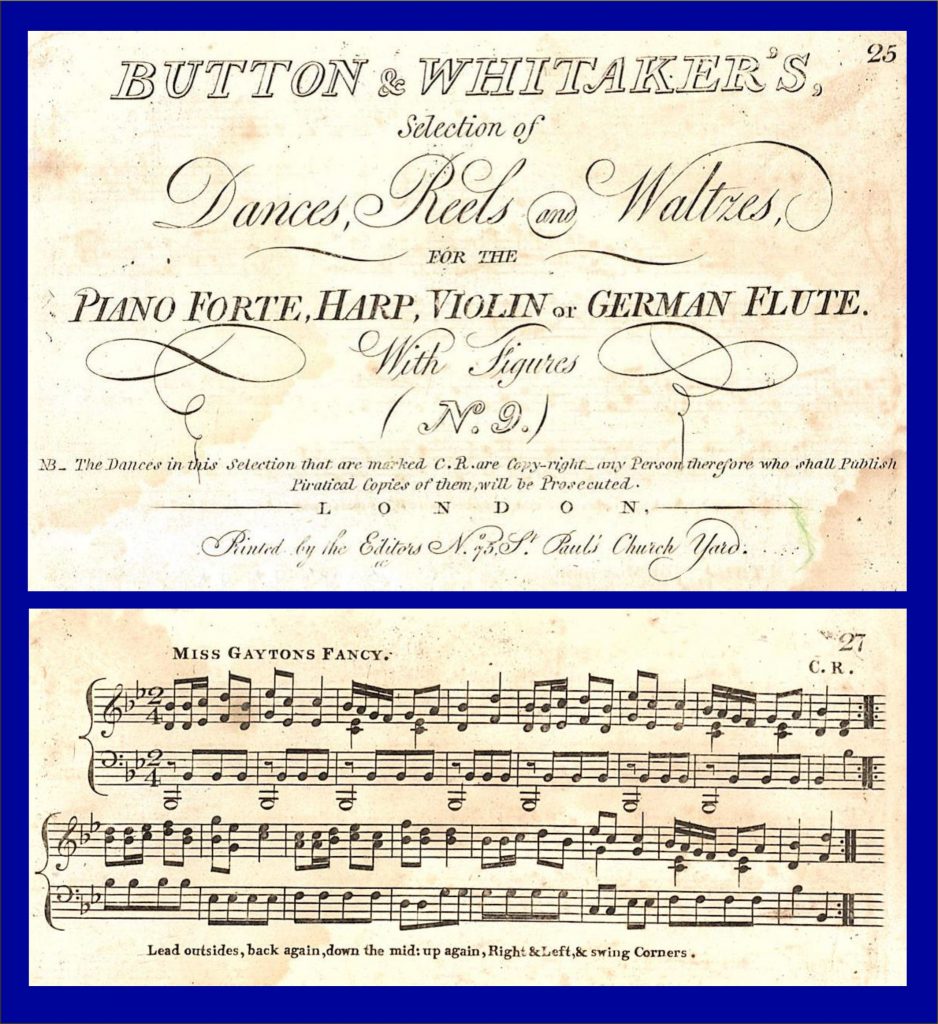
It’s difficult to be definitive about the composers of either of these two tunes. The hornpipe might have been written either by James Hook for Tekeli (November 1806) or by Henry Bishop for Love in a Tub (November 1808). Miss Gayton’s Fancy only appears once under that name, in the publication above, where it follows a tune called simply Caractacus, so it could have been composed for that ballet by Henry Bishop (March 1808); however, the melody for Esther Gayton’s Pas Seul in Bishop’s original score is not the same tune, and it’s not the Hornpipe either. I have not been able to inspect the scores for Tekeli or Love in a Tub.
The tune and country dance Miss Gayton’s Hornpipe were published many times (in collections of country dances, mostly printed in London) from the initial printing during Esther’s dancing heyday until 1817, with Button and Whitaker claiming the copyright under new laws in 1814. After 1817 I have found no instances of it in print for a number of years, but there are many instances of the tune being copied out into fiddler’s private manuscripts. In 1850 it was deemed well known enough to be suggested as an air for a song on a broadside printed in Manchester. This suggests it was in widespread use by musicians 1817-1850, possibly more amongst amateurs than professionals in this period. The tune came back into vogue in the 1880s, and was then published a good number of times for the next hundred years, but almost exclusively in Scotland, perhaps reflecting dance tastes in that long period.
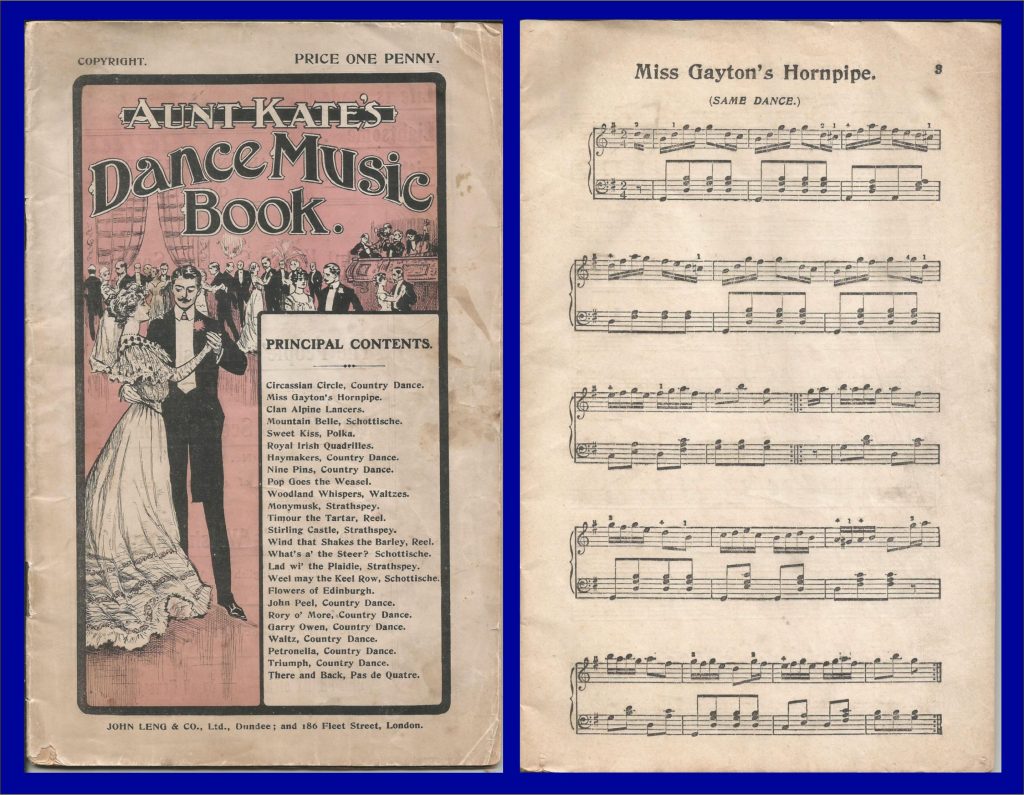
A publication dating from just shy of a century after the first appearance of Miss Gayton’s Hornpipe – Aunt Kate’s Dance Music Book includes what is recognisably the same tune, albeit transposed into G, given a 2:4 time signature instead of (cut common time), and with a slightly simplified ending. This booklet was published in December 1904 (announced in the Sheffield Daily Telegraph, 10th December) and was part of a series of publications by J. Leng, of Dundee and London, including Aunt Kate’s Conjuring and Parlour Magic and Aunt Kate’s Knitting and Crochet Book, which was evidently aimed at women. The preface to our dance book states: “The publishers anticipate that the present collection will appeal to a large circle of those who are interested in parties and kindred gatherings … [the] aim has been to provide a book suited to average requirements, one that would be equally serviceable in the ball-room and in the home. With this object in view, no popular dance has been omitted.” There are no dance instructions, the only other tunes which gets the direction “same dance” are Pop goes the Weasel, John Peel and Garry Owen, which today are all much better known tunes that Miss Gayton’s Hornpipe, but all the associated dances have faded equally into obscurity.
From 1990 to date the tune has again been published a good many times: in those thirty years mostly in England and the USA.
If you are interested in the many and various publications and manifestations of the dance, there is a link at the end of this article to a PDF summarising the dates and sources. If you come across any other instances, please do get in touch!
The Traditional Tune Archive also has a good page online covering most of the publications for which there is actually a score available – see Further Information at the end of this article.
Stepdance routine
However it was not this social dance to which my attention had originally been drawn by Simon Harmer.
Simon is a wonderful stepdancer and knew of a stepdance routine called Miss Gayton’s Hornpipe, collected in south west Scotland by Tom & Joan Flett in 1959. The lady who demonstrated this dance to the Fletts was Elizabeth Porter Wallace, whom the Fletts noted as being 65 at the time. She was a dancing teacher whose father, grandfather (Joseph Rae Wallace) and grand-uncle (Alexander, known as Sandy Porter – his mother’s maiden name) had all taught dancing in the Kilmarnock area. The Fletts had her name as “Miss Elizabeth Wallace” but although she used this name professionally, she had in fact married in 1925, to Thomas Parker. Elizabeth (1893-1983) seems to have taken a break from teaching from 1924 until 1937, coinciding with the birth of a son, who tragically died at a very young age. There was apparently no next generation to take on the dance teaching mantle, and I can find no trace of Elizabeth in the newspapers after 1938.
However, one newspaper from 1908 reveals her father, Joseph Wallace (1856-1932) teaching the very dance under discussion!
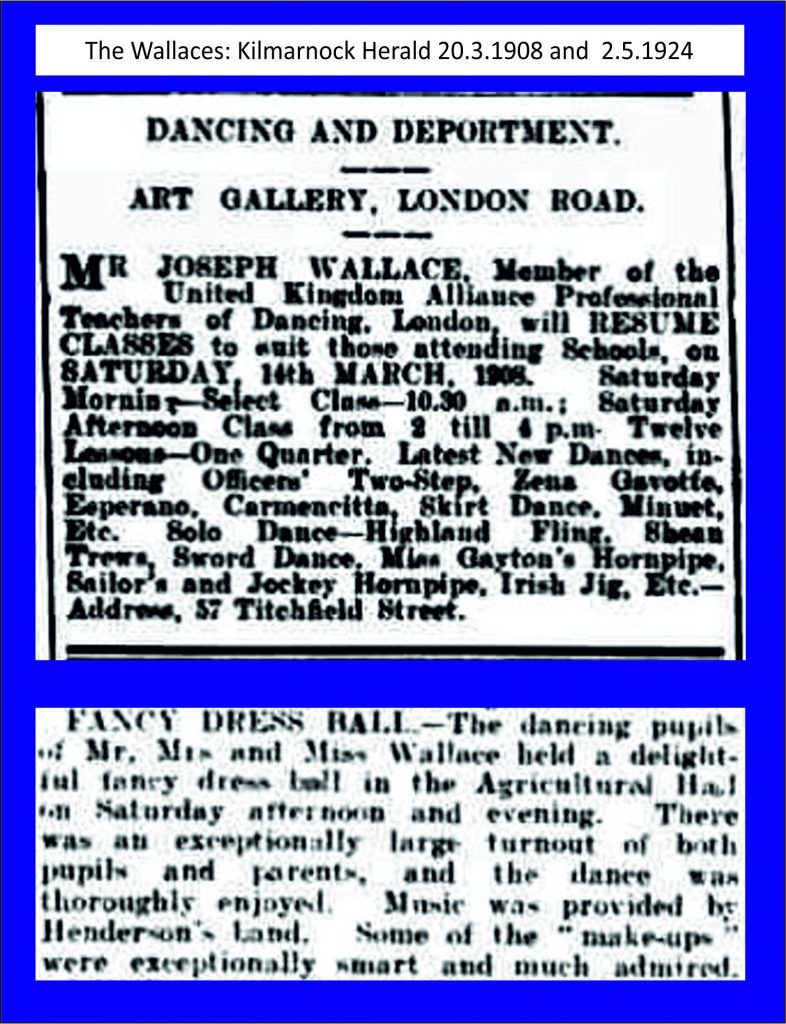
Joseph reputedly had a large repertoire of social dances and a collection of early ballroom guides as well as “a large repertoire of solo dances, some of which he undoubtedly learned from his own father and uncle” according to Tom and Joan Flett in Traditional Stepdancing in Scotland (p.151). They also state that “Miss Gayton’s Hornpipe was taught by Wallace to his young girl pupils, usually aged about eight to twelve years old. They held their dresses slightly out to the side with their thumbs at the back. Three morris dance type bells sewn to a band of elastic at each wrist.” They were unaware of exactly who Miss Gayton was, and surmised that the dance was probably made up by a dancing teacher for a favoured pupil – a not unreasonable supposition, and not too far off the mark. We do not have conclusive proof that this dance was actually danced by Esther Gayton, but we do know that as early as 1829 a Miss Gayton’s Hornpipe stepdance routine was being taught by dancing masters, so the odds on it referring to a different Miss Gayton are slight.
The 1829 reference comes from a programme for “Mr. Lowe’s third annual ball” in the assembly room in Elgin. The original programme is in the National Library of Scotland but my source is a typewritten transcription reprinted in The Thistle, the newsletter for a Scottish dance society in Vancouver, in 1972/3. The programme reveals, at number 18 out of 29 items in the first half alone, Miss Gayton’s Hornpipe, danced by four girls. So this was an end-of-term show for the pupils of Mr. Lowe, a dancing teacher, rather than a society ball for adults.
Writing in 1972, the author of the article in The Thistle reflected on the repertoire of dances from the ball: “Apart from the fling and reel steps, most of this material has been lost. The only dance from this programme which has been preserved is Miss Gayton’s hornpipe (collected and taught by Joan and Tom Flett).”
The Fletts did not know of the Lowe connection with this specific dance, but they did know that Joseph Wallace had in his collection a copy of The Ball Conductor. This book was first published in 1822 in Edinburgh, by the four Lowe brothers: Joseph, James, Robert and John, and was republished again in 1830 and 1860. The Mr Lowe referred to in the 1829 ball programme would be John Lowe, who was probably the first of the brothers to open a dancing school. His brother Joseph had been teaching in Elgin, but by early 1827 John had taken over from him, continuing to teach in Perth as well until his death in January 1839. I am indebted to Paul Cooper for much of the information about the Lowes.
A colleague in Australia, Heather Clarke has kindly sent me newspaper references to the dance being taught in a similar context of juvenile balls from at least 1894 to 1911, in and around Bathurst, New South Wales. The progenitors there were various members of another dynasty of dancing teachers, the Allison family.
A modern interpretation of the stepdance
Although we cannot know if the steps now known as Miss Gayton’s Hornpipe are the same as Esther Gayton danced in the first decade of the nineteenth century, the expert opinion is that they are likely to be very similar. In private correspondence with Simon Harmer, Anne Daye (Director of Education and Research for the Historical Dance Society) commented “There is nothing in the step sequence that would be unknown in her day; the opening sequence uses ballonnés or cuts common in social dancing; heel and toe combinations are timeless; shuffles ditto; backskips as in the break are footing steps (feature of my presentation), so the dance is the closest we can get today to Miss Gayton’s performance. She may not have done the same step sequence at each performance, and she would have done the dance in a showier manner, perhaps using her skirts a bit more, making a flourish of the fancier steps, maybe a circling of the stage on the intro.”
Simon learned the dance after being inspired by the story of the barrel organ being taken on board William Edward Parry’s ships on his searches for a North West passage from the Atlantic to the Pacific in 1819-1825. The barrel organ contained five barrels, each having eight tunes, the majority of which were contemporary dance tunes, including Miss Gayton’s Hornpipe. More detail about this is in Part One: the Ballerina and the Baronet and also A Barrel Organ in the Arctic.
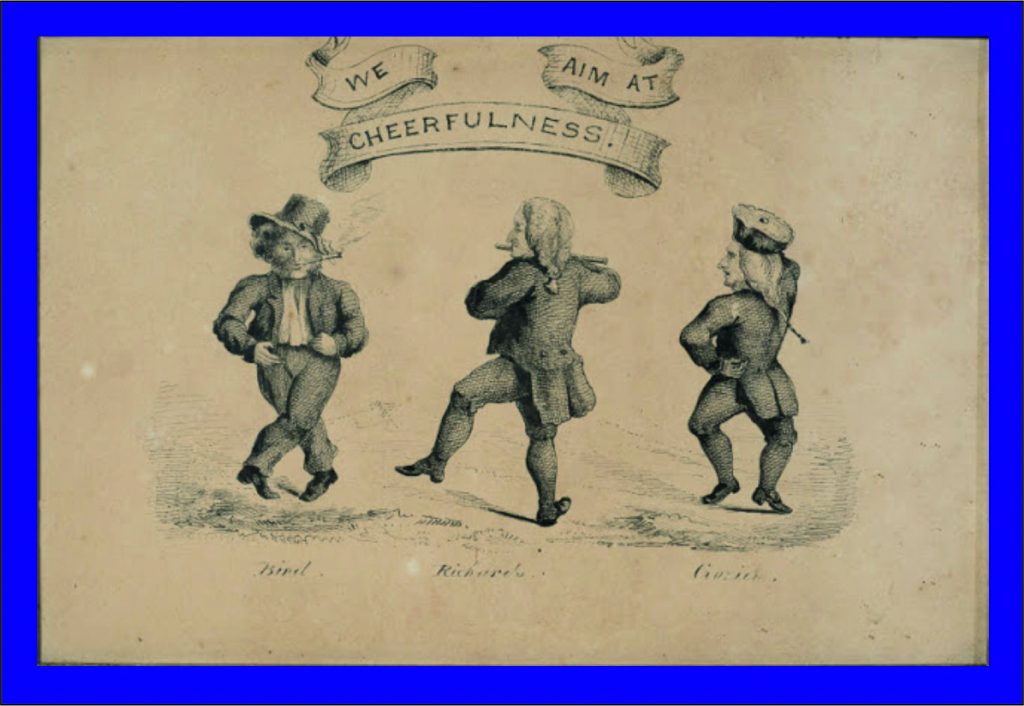
Having seen the illustration above of three midshipmen stepping – dating from Parry’s third Arctic voyage in 1825 – Simon went back to the Fletts’ notation, and to Chris Metherell, who had been taught the Wallaces’ version of Miss Gayton’s Hornpipe by Joan Flett, and to Lesley Gowers, who had learned it from Jennifer Millest, again taught by Joan Flett. Simon reinterpreted it in a more robust style, as might have befitted a midshipman of the nineteenth century. For his version of Miss Gayton’s Hornpipe Simon added arm positions from the Staub illustration and other contemporaneous images of sailors dancing.
Simon comments on this illustration that Edward Bird (on the left) could be dancing Step 5 of the sequence, and Francis Crozier (on the right) Step 3 or 6. In this illustration by the otherwise unknown C. Staub, they have a live musician, Charles Richards, rather than the barrel organ to dance to. The midshipmen look so carefree in this illustration – however, although Bird went on to have a distinguished Naval career, Crozier was to perish on the ill-fated Franklin expedition to find the North West Passage.
Here is a video of Simon Harmer dancing Miss Gayton’s Hornpipe to the playing of Will Allen.
In the autumn of 2020 Simon took this one step further, when the research into Esther Gayton and the hornpipe named after her was the heritage focus for the Step Your Way dance project in Portsmouth. The young dancers were introduced to the idea that dance styles evolve from many different influences. Information based on our researches was provided to back up what the dancers were experiencing physically: a journey from the hornpipe, through creolisation with black dance, to current urban styles. You can see the Step Your Way output video here.
For a full list of all the instances I have found of Miss Gayton’s Hornpipe – tune and dance, publication, collection and mentions, you can read this PDF file: Miss Gayton’s Hornpipe (history) Please remember, if you’d like to use this information, acknowledge this as your source!
Part One of this article is Esther Gayton: the Ballerina and the Baronet
See also A Barrel Organ in the Arctic and Will the real Paddy O’Rafferty please stand up!
A huge number of people have helped discuss various aspects of this research, my thanks to them all, especially, for this second article: Heather Clarke and Paul Cooper for information and discussions about the historical aspects of the dance and tune; Adrian Turner for giving me Aunt Kate’s Dance Music book (with no idea it would come in useful in this way); Chris Partington, Nick Barber, Paul Burgess, Rob Say, Derek Schofield, Will Allen, Anne Daye and last but absolutely not least, another huge thank you to dancer and researcher SIMON HARMER for the inspiration on these stories and specifically for his contributions to the section on the stepdance routine.
Further Information
Many of the tunes from Parry’s barrel organ were recorded following restoration in 1972, and that album – Parry’s Barrel Organ – is still available on the Saydisc label.
Miss Gayton’s Hornpipe is the second of two tunes on track 5 on the album: neither of which were identified at the time the recording. The first tune is the 48 bar jig Paddy Carey and both were originally on barrel no. 5.
At the time of writing it is also available to listen to on YouTube here.
A brief history of the tune may be found on the Traditional Tune Archive website.
The social dance Miss Gayton’s Hornpipe is shown in a moving diagrammatic form on Paul Cooper’s Regency Dances website here and also Miss Gayton’s Fancy here.
Digital images of these tunes and their associated social dances in their original settings may be found here: Miss Gayton’s Hornpipe and Miss Gayton’s Fancy.
Thomas Lowe’s 1829 ball programme is transcribed in The Thistle (December 1972) and more about Thomas Lowe and his brothers can be found in research paper No. 24 The Lowe Brothers – Teachers of Dancing in Scotland on the Regency Dances website, by Paul Cooper.
Heather Clarke, who supplied the information about Miss Gayton’s Hornpipe being taught in Australia, has a superb website about dancing in early colonial Australia.
The Fletts’ handwritten notes may be found on the Instep Research Team‘s website, which holds a treasure trove of such original material. Here is a direct link to the relevant Flett notes. Tom Flett’s notes and notation from Elizabeth Wallace are on pp 13-35, with the steps for Miss Gayton’s Hornpipe on pp 16-20. The dance notation may also be found in the Fletts’ 1996 book Traditional Stepdancing in Scotland, pp 151-156.
Please note: Anyone wishing to cite this original research should credit it to Katie Howson and cite this website as the source. © Katie Howson, 2021.
I have unearthed far more material on Esther Gayton’s performances and personal life, the tune, and the dance, than can be written up here. Please do get in contact if this is a special area of interest or study to you, I would be happy to tell you more.
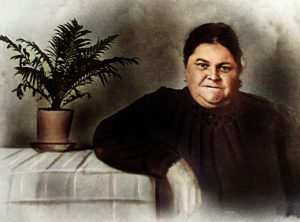
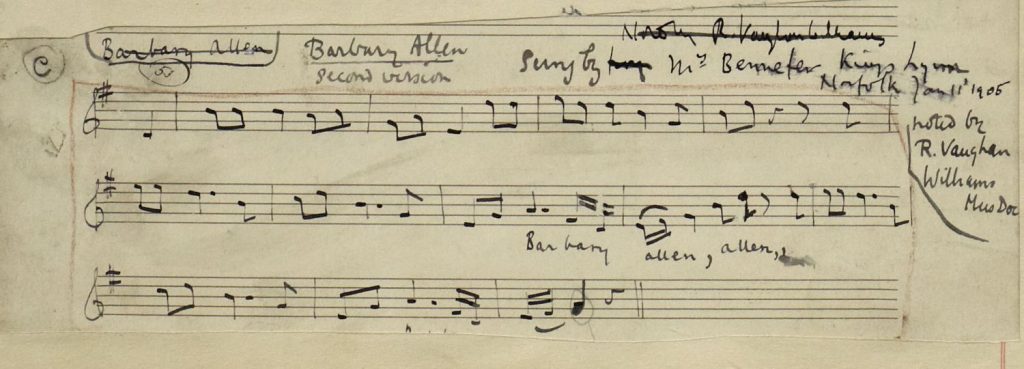
 Ask people interested in local history in King’s Lynn, Norfolk, if they’ve heard of Lol Benefer and they might quite likely answer “Oh yes!” and raise their eyebrows knowingly. Ask people interested in folk songs if they’ve heard of her, and they will probably shake their heads and raise their eyebrows quizzically.
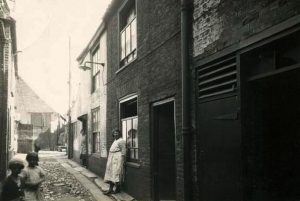 In Kings Lynn Vaughan Williams headed for the area around St Nicholas Chapel, just north of the large Tuesday Market Place, known as the North End, home to the fishing community based around the old Fisher Fleet. He visited people living in some of the yards, such as Whitening Yard (left, in the 1930s), off North Street. This area has since changed beyond recognition; most of the houses, shops and pubs that formed a poor but vibrant, self-contained, even isolated, community having been demolished in the slum clearances of the mid twentieth century.

Recent Comments